

In an industry obsessed with bright new frameworks and fast-moving languages, Python remains an absolute titan. It powers early-stage startups, massive machine learning pipelines, backend web services, and scientific research.
Why does a language designed in 1989 continue to dominate in 2026?
It comes down to developer velocity. Python trades low-level syntax ceremony for immediate expressiveness. You write fewer lines of code, read plain-English syntax, and ship solutions in hours rather than days.
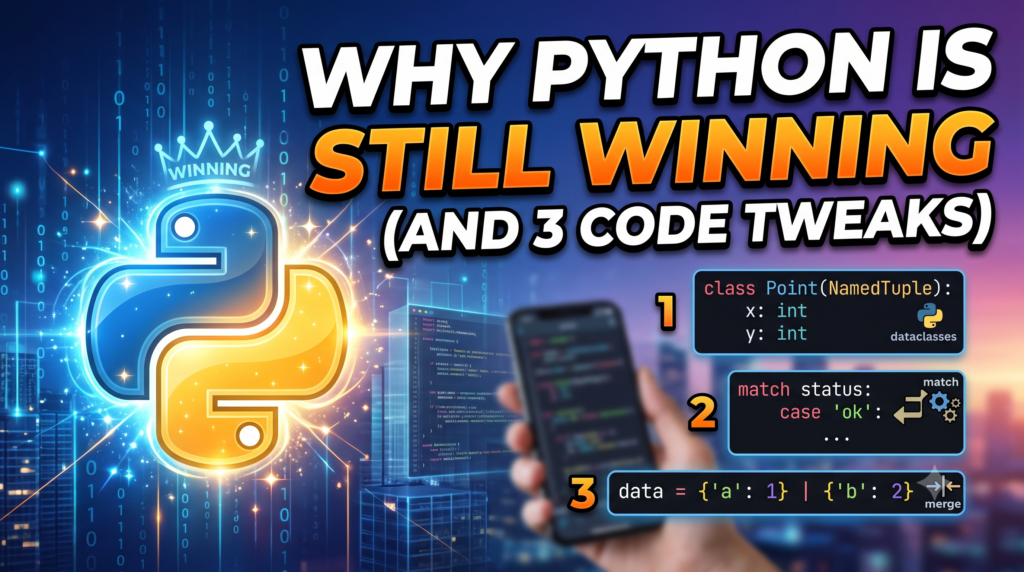
However, Python hasn’t stayed dominant by remaining static. The language has quietly evolved into a fast, explicit, and modern ecosystem. If your Python style hasn’t changed in a few years, here are 3 quick code tweaks you can use today to write cleaner, faster, and more maintainable code.
Tweak 1: Ditch Heavy Objects for dataclasses or slots
When storing simple data structures, traditional Python classes come with significant boilerplate, and plain dictionaries offer no autocompletion or structure.
Using @dataclass automatically generates methods like __init__ and __repr__. If you handle thousands of instances and want to cut memory usage, adding slots=True prevents dict creation per instance.
The Old Way
Python
class User:
    def __init__(self, name: str, email: str, role: str):
        self.name = name
        self.email = email
        self.role = role

    def __repr__(self):
        return f"User(name={self.name}, email={self.email}, role={self.role})"
The Modern Way
Python
from dataclasses import dataclass

@dataclass(slots=True)
class User:
    name: str
    email: str
    role: str

# Clean initialization, concise repr, and optimized memory footprint!
user = User("Alex", "alex@example.com", "Admin")
print(user)  # Output: User(name='Alex', email='alex@example.com', role='Admin')
Tweak 2: Simplify Conditionals with match / case
Nested if-elif-else blocks get messy quickly—especially when parsing JSON responses, configuration options, or complex dictionary paylodas. Structural Pattern Matching provides a clean, declarative syntax for checking structure and extracting values at the same time.
The Old Way
Python
def process_event(event: dict):
    if event.get("type") == "click":
        return f"Clicked at ({event.get('x')}, {event.get('y')})"
    elif event.get("type") == "keypress":
        return f"Pressed key: {event.get('key')}"
    else:
        return "Unknown event"
The Modern Way
Python
def process_event(event: dict):
    match event:
        case {"type": "click", "x": x, "y": y}:
            return f"Clicked at ({x}, {y})"
        case {"type": "keypress", "key": key}:
            return f"Pressed key: {key}"
        case _:
            return "Unknown event"
Tweak 3: Replace Verbose Merges with the Pipe Operator (|)
Merging dictionaries or unioning type hints used to require verbose syntax like .update(), dict(d1, **d2), or importing Union from the typing module. Modern Python introduced the union operator (|) to streamline both operations.
The Old Way
Python
from typing import Union

# Union typing
def parse_id(val: Union[int, str]) -> int:
    return int(val)

# Dictionary merging
defaults = {"theme": "dark", "notifications": True}
user_settings = {"theme": "light"}

settings = defaults.copy()
settings.update(user_settings)
The Modern Way
Python
# Union typing with |
def parse_id(val: int | str) -> int:
    return int(val)

# Dictionary merging with |
defaults = {"theme": "dark", "notifications": True}
user_settings = {"theme": "light"}

settings = defaults | user_settings  # {'theme': 'light', 'notifications': True}
Keep Your Python Skills Sharp
Small syntax upgrades like these make codebases easier to maintain, less prone to bugs, and more enjoyable to work on. Python’s longevity isn’t a fluke—it’s the result of continuous refinement.